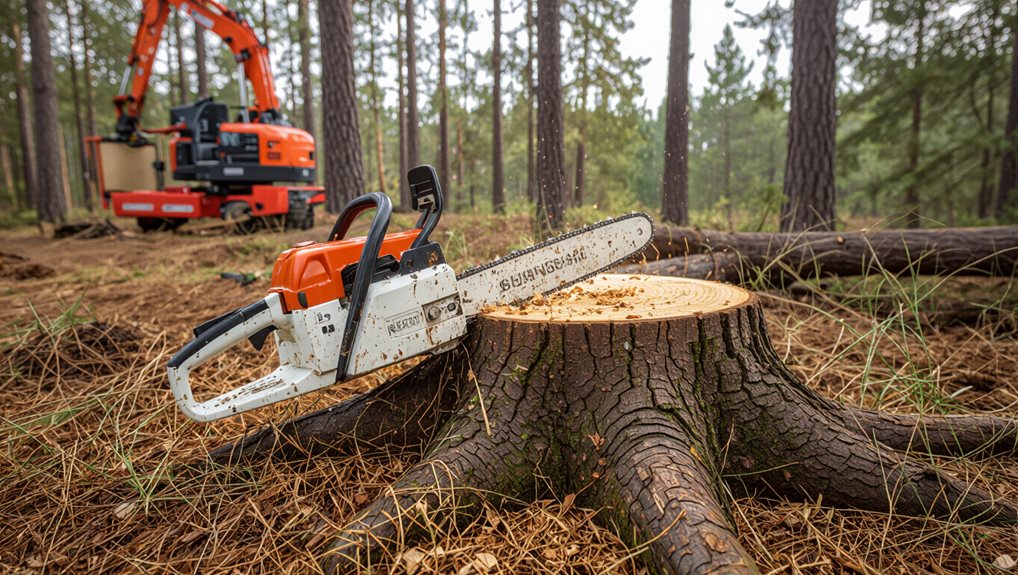
Tree removal creates significant environmental tradeoffs you should consider. While it disrupts carbon sequestration, causes soil erosion, and destroys wildlife habitats, strategic removal can benefit ecosystems when targeting invasive species or reducing wildfire risks. You’ll need to balance safety concerns with ecological impacts by implementing mitigation strategies like buffer zones, selective harvesting, and replanting native species. Proper planning helps minimize negative consequences while maximizing potential benefits to forest health and resilience.
Expert Highlights
- Tree removal reduces carbon sequestration, increasing atmospheric CO2 levels and contributing to global warming.
- Removing trees accelerates soil erosion, potentially causing mudslides, waterway clogging, and decreased water quality.
- Strategic tree removal creates defensible space for fire mitigation and can protect structures from wildfire damage.
- Proper forest management through selective tree removal can stimulate forest regeneration and increase biodiversity.
- Urban tree removal requires balancing safety concerns with lost environmental benefits like shade and stormwater management.
Carbon Cycle Disruption and Atmospheric Impacts

When trees are removed from an ecosystem, the carbon cycle—a natural process that regulates Earth’s climate—becomes noticeably disrupted, leading to far-reaching atmospheric consequences. You’ll find that trees act as critical carbon sinks, absorbing CO₂ during photosynthesis and storing carbon in their trunks, branches, and roots. Without them, atmospheric carbon dioxide levels rise, intensifying global warming effects in your community and beyond.
The solution involves strategic forestry management. You can support reforestation efforts that help restore balance to disrupted ecosystems. When you participate in community tree-planting initiatives, you’re directly contributing to carbon sequestration. Additionally, advocating for sustainable logging practices guarantees harvested trees are replaced, maintaining the carbon cycle’s integrity. By understanding these connections, you’re empowered to make choices that benefit both local environments and global atmospheric health.
Soil Erosion and Watershed Effects

When you remove trees from hillsides or riverbanks, you’re removing the natural root systems that hold soil in place during rainfall, leading to accelerated erosion rates that can exceed 100 tons per acre annually. You’ll notice this erosion manifests as mudslides, clogged waterways, and decreased water quality as sediment carries pollutants into streams and rivers. Implementing watershed protection strategies like selective harvesting, maintaining buffer zones of vegetation near waterways, and installing erosion control measures can reduce these impacts by up to 80% while preserving water quality for downstream communities.
Erosion Risk Factors
Although trees act as natural barriers against land degradation, their removal exposes soil to destructive forces that can trigger widespread erosion. You’ll find several key risk factors that determine erosion severity after tree removal. Slope gradient is critical—steeper slopes experience faster water runoff and soil displacement. Soil composition matters too; sandy soils erode more easily than clay-rich alternatives. Your local climate patterns, particularly rainfall intensity and frequency, greatly influence erosion potential.
The timing of tree removal greatly impacts risk levels. When you clear trees during rainy seasons, you’re facing considerably higher erosion threats. Additionally, the scale of removal matters—large clearcuts create more vulnerability than selective harvesting. By understanding these factors, you’ll be better equipped to implement appropriate erosion control measures that protect your land’s long-term health and productivity.
Watershed Protection Strategies
Because tree removal greatly alters watershed dynamics, implementing effective protection strategies becomes essential for maintaining hydrological balance. When you clear trees without proper planning, you’ll face increased runoff, sediment loading, and potential flooding that can devastate downstream communities and ecosystems.
You can mitigate these risks by establishing vegetative buffer zones along waterways, which trap sediments and filter pollutants before they enter streams. Strategic replanting with native species will help restore root systems that stabilize soil and regulate water flow. Consider installing retention basins in areas where you’ve removed significant tree cover; these structures capture excess runoff during heavy rainfall events, allowing water to infiltrate gradually rather than causing flash floods. By implementing these protection measures, you’ll preserve water quality and safeguard both property values and ecological health within your watershed.
Wildlife Habitat and Biodiversity Considerations

When you remove trees from an ecosystem, you’re fundamentally eliminating essential wildlife habitat that countless species depend on for their survival, potentially displacing animals who can’t easily relocate to suitable alternative environments. You’ll notice particularly severe consequences for cavity-dependent animals like woodpeckers, owls, and flying squirrels, which rely specifically on mature trees for nesting sites and shelter that cannot be quickly replaced. Your decision to remove trees directly influences local biodiversity, creating ripple effects through the food web as insect populations change, predator-prey relationships shift, and the complex ecological balance that supports diverse plant and animal communities becomes destabilized.
Habitat Loss Assessment
As trees disappear from landscapes, countless wildlife species face immediate displacement and long-term survival challenges. You’ll notice these impacts most dramatically when mature trees are removed, as they often serve as keystone habitat elements supporting entire ecological communities. When evaluating potential habitat loss, you need to take into account both direct consequences (nesting sites, food sources) and indirect effects (microclimate changes, predator-prey dynamics).
Before removing trees, conduct a thorough habitat evaluation that identifies resident and migratory species dependencies. You can mitigate unavoidable losses by creating wildlife corridors, installing nest boxes, or establishing conservation easements nearby. Remember, even selective thinning affects understory vegetation that ground-nesting birds and small mammals rely upon. Your careful evaluation and thoughtful mitigation strategies will help preserve biodiversity while still meeting necessary management objectives.
Species Displacement Effects
Tree removal directly triggers a cascade of displacement effects that ripple throughout local ecosystems, forcing wildlife to compete for increasingly scarce resources. When you remove trees, you’re eliminating essential wildlife habitats that can’t be quickly replaced, resulting in population declines across numerous species.
- Birds lose nesting sites and food sources, causing them to relocate or struggle to reproduce successfully
- Small mammals face increased predation risk without protective cover, disrupting predator-prey relationships
- Insect populations experience dramatic shifts that affect pollination patterns and plant reproduction cycles
To mitigate these impacts, you can implement phased removal schedules that allow wildlife to adapt gradually, install artificial habitats like nest boxes during adjustment periods, and preserve habitat corridors connecting remaining wooded areas. These strategies help maintain biodiversity while addressing legitimate tree removal needs.
Cavity-Dependent Animals Impacts
Because cavity-dependent wildlife species rely exclusively on tree hollows for survival, their populations face severe disruption when mature trees are removed from ecosystems. Woodpeckers, owls, flying squirrels, and numerous bat species depend on these natural shelters for nesting, protection from predators, and raising their young. When you remove a single mature tree containing multiple cavities, you’re potentially eliminating homes for dozens of animals.
You can mitigate these impacts by conducting pre-removal surveys to identify cavity trees, preserving snags (dead standing trees) when they don’t pose safety hazards, and installing artificial nest boxes as temporary alternatives. The most effective strategy involves retaining clusters of mature trees throughout your property. This approach creates wildlife corridors that maintain habitat connectivity, allowing cavity-dependent species to persist despite limited tree removal elsewhere.
Managing Invasive Tree Species for Ecological Health
While invasive tree species can devastate local ecosystems, you’ll need a strategic management approach to address this growing environmental threat. Non-native trees like the Tree of Heaven or Brazilian Pepper can outcompete native vegetation, disrupt wildlife habitats, and alter soil chemistry, leading to biodiversity loss across your landscape.
Consider these evidence-based management strategies:
- Prioritize removal of female seed-bearing trees first to prevent further spread while gradually addressing the remaining population
- Combine mechanical removal with targeted herbicide treatments to prevent aggressive resprouting
- Replant cleared areas with native species immediately to prevent soil erosion and recolonization by other invasives
You’re not just removing trees—you’re resetting ecological balance. By implementing these practices, you’ll help restore native plant communities and create healthier habitats for local wildlife species.
Fire Mitigation Through Strategic Tree Removal
As devastating wildfires become increasingly common across drought-stricken landscapes, you’ll need to implement strategic tree removal as an essential component of your fire prevention toolkit. When you create defensible space around structures, you’re considerably reducing fuel loads that could feed advancing flames. Start by removing trees within 30 feet of buildings, focusing on conifers with low-hanging branches that act as fire ladders.
Beyond your immediate perimeter, thin dense stands by removing smaller, suppressed trees while maintaining 10-15 feet between mature tree crowns. This prevents dangerous crown fires that jump rapidly from tree to tree. You’ll want to prioritize removing diseased or dead trees first, as these ignite more easily than healthy specimens. This selective approach maintains ecological benefits while markedly reducing the risk of catastrophic wildfire reaching your property.
Urban Tree Management: Balancing Safety and Environment
In urban environments where concrete and asphalt dominate, the management of trees requires careful consideration of competing priorities that affect thousands of residents daily. You’re often faced with difficult choices when a mature oak threatens utility lines or when roots damage sidewalks used by elderly neighbors. Safety concerns must be balanced against environmental benefits that these urban forests provide.
Urban forestry means balancing safety against the vital ecological benefits trees provide to city dwellers.
When evaluating urban trees, consider these essential factors:
- Structural integrity of the tree, including signs of disease or instability
- Proximity to infrastructure such as power lines, buildings, and walkways
- Ecological value including shade provision, wildlife habitat, and stormwater management
Forest Regeneration Following Selective Removal
Unlike clear-cutting methods that devastate entire ecosystems, selective tree removal creates opportunities for forest regeneration through carefully managed intervention. When you selectively remove trees, you’re creating gaps in the forest canopy that allow sunlight to reach the forest floor, stimulating new growth and increasing biodiversity. This process mimics natural disturbances, such as when older trees fall during storms.
You’ll notice significant benefits within 3-5 years, including increased seedling establishment, greater herbaceous plant diversity, and improved habitat for wildlife that depends on forest edges. However, careful planning is essential. You must identify which trees to remove based on species, health, and location to avoid soil compaction and damage to remaining vegetation. When done properly, selective removal accelerates forest succession and creates a more resilient ecosystem that you’ll be proud to steward.
Climate Resilience and Adaptive Forest Management
While forests face unprecedented threats from rising temperatures and extreme weather events, climate-resilient tree management offers a powerful strategy to safeguard these essential ecosystems. You’ll find that adaptive management approaches prioritize diversity and resilience rather than focusing solely on timber production or singular objectives. When you’re planning forest interventions, consider these climate adaptation strategies:
Forests demand climate-smart strategies that prioritize ecological resilience over single-purpose management in our warming world.
- Diversifying tree species to reduce vulnerability to pests and diseases that thrive in changing climate conditions
- Removing stressed or vulnerable trees to reduce competition for limited water resources during drought periods
- Creating mosaic patterns of different-aged stands to enhance landscape-level resilience against catastrophic fires
Sustainable Practices in Commercial Timber Harvesting
Commercial timber operations represent a cornerstone of forest management that, when executed responsibly, can align economic objectives with environmental stewardship. You’re likely aware that clear-cutting practices have historically degraded ecosystems, but today’s sustainable harvesting methods offer promising alternatives.
When you implement selective harvesting, you’ll maintain forest structure while removing only mature trees, preserving biodiversity and soil health. You can further enhance sustainability through reduced-impact logging techniques that minimize soil compaction and protect waterways. Certification programs like FSC provide frameworks for your operations to meet rigorous environmental standards.
Frequently Asked Questions
How Much Does Professional Tree Removal Typically Cost?
You’ll typically spend $500-$1,500 for professional tree removal, depending on your tree’s size, location, and accessibility. Prices can reach $2,000+ for larger or complex removals.
Can I Legally Remove Trees on My Property Without Permits?
You’ll need to check local regulations since tree removal laws vary by location. Many areas require permits for certain trees, especially if they’re protected, large, or in conservation zones.
What Happens to Removed Tree Waste and How Is It Recycled?
You’ll find your tree waste often becomes mulch, firewood, or lumber. Many cities offer curbside collection services, or you can drop it at recycling centers that’ll transform it into useful products.
How Do Different Tree Removal Methods Compare in Environmental Impact?
You’ll find chainsaw felling creates noise pollution, while crane removal minimizes ground damage. Mulching offers on-site recycling benefits, but chemical methods can harm surrounding ecosystems without proper containment.
When Is the Best Season to Remove Trees?
You’ll want to remove trees in late fall to winter when they’re dormant. It’s less disruptive to wildlife, reduces disease spread, and allows for easier site access.
Expert Final Thoughts
When considering tree removal, you’re facing a complex balance of environmental trade-offs. Your decisions impact carbon storage, soil stability, wildlife habitats, and community safety. By approaching removal with careful assessment, selective practices, and replanting strategies, you’ll minimize negative consequences while maximizing ecological benefits. Remember that thoughtful management creates healthier, more resilient landscapes. Every tree matters—whether it stays or goes should reflect both immediate needs and long-term environmental stewardship.